ÁNGELA PÉREZ CAMBLOR Y PAULA LLANA PEÑA, 3º B.


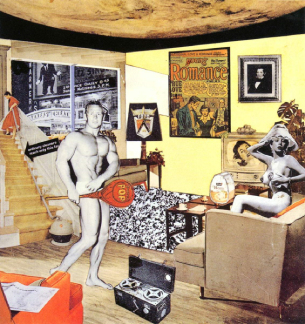
He was born in Pittsburgh, USA in 1928. His parents were from Czech Republic. He started her art studies by the 1950’s at the Carnegie Technology Carnegie Institute. The last year he started a degree as commercial artist for magazines as Vogue, Harper´s Bazaar, Seventeen y The New Yorker. At the same time he used to paint canvas using thematic about daily elements, advertisement and comics and he started exposing in different galleries. 

e disappear.
Pollock was born in Cody, Wyoming (USA) on January 28th in 1912. After his childhood in Cody, he went to New York, where he studied in the Art Students League. Soon, his work started being abstract and surreal. Between 1935 and 1943, Pollock worked for the WPA and painted under Picasso's influence. Besides, since 1938, he worked as well for the Federal Art Project. All this made Pollock meet and know many different styles, techniques (like air pump paint or airbrush) and materials (like varnish or synthetic enamel). Pollock married Lee Krasnernin 1945, who backed him to keep painting and to control his alcoholism. Since 1949, he was paid a monthly payment from Peggy Guggenheim, who became his patron. In 1956, when he had already got over his vices, Pollock died surprisingly in a terrible car accident, at the early age of 44.
"Number 8" doesn't show any image or even a feeling. In fact, it has no title which can describe the picture. As Pollock said, he doesn't want to show anything, it's only an action, a fact. This is one of the characteristics of many Pollock's paintings.


Henry Toulouse Lautrec
Henry Toulouse Lautrec was a French painter, he was born in Albi on 24th of November 1864 in an aristocratic family. He died in 1901 from complications due to alcoholism and syphilis when he was 36 years old.
At the age of 13 Henry fractured his two legs and ceased to grow ,he developed an adult torso with children´s legs. He was an adult only 1`54 m tall.
Since childhood he had a great fondness with painting and drawing. He went to Paris to study with León Bonnat. After it he worked in the studio of Fernand Cormon and he met Van Gogh. Hall of Rue des Moulins
He became an important Post-impressionist painter, art nouveau illustrator and lithographer and recorded in his works many details of the late-19th century Bohemian lifestyle in Paris. The Moulin Rouge cabaret reserved a seat for him and displayed his paintings.
His painterly style which is highly linear and gives great emphasis to contour.
Toulouse-Lautrec created canvases, watercolours, prints and posters,drawings, some ceramic and stained glass work, and an unknown number of lost works.
PAINTINGS:
Self-Portrait in the mirror (oil on cardboard, 1880)
Lacayo of chivalry with two horses (oil on cardboard, 1880)
Count Alphonse de Toulouse-Lautrec driving your car with four horses (oil on canvas, 1881)
The artist's mother, Countess Adèle de Toulouse-Lautrec, breakfast in the Castle Malromé (oil on canvas, 1881-1883)
The young Routy in Céleyran (oil on canvas, 1882)
The fat Marie (oil on canvas, 1884)
The Sandpiper (oil on canvas, 1884)
Portrait of Vincent van Gogh (pastel on cardboard, 1887)
Amazon at the Circus Fernando (oil on canvas, 1888)
To Wed (oil and gouache on cardboard, 1891)
Mademoiselle Marie Dihau the piano (oil on cardboard, 1890)
The actor Henry Samary (oil on cardboard, 1889), Musée d'Orsay, Paris
At the Moulin de la Galette (oil on canvas, 1889)
Dance At The Moulin Rouge (oil on canvas, 1890)
Moulin Rouge: La Goulue (color lithograph, 1891)
Reine de joie (color lithograph, 1892)
Ambassadeurs: Aristide Bruant (color lithograph, 1892)
The Englishman at the Moulin Rouge (oil and gouache on cardboard, 1892)
At the Moulin Rouge: Two women dancing (oil on cardboard, 1892), National Museum
Prague, Prague
Divan japonais (color lithograph, 1892-1893)
Yvette Guilbert (gouache on cardboard, 1894, Museo Thyssen-Bornemisza, Madrid)
Garden of Paris, Jane Avril (lithograph in colors, 1893)
Confetti (color lithograph, 1894)
Hall of Rue des Moulins (oil on canvas, c. 1894), Toulouse-Lautrec Museum, Albi
The clown Cha-U-Kao (oil on cardboard, 1895), Musée d'Orsay, Paris
The passenger cabin (color lithograph, 1896)
The bath (color lithograph, 1896)
La Toilette (oil on cardboard, 1896) Musée d'Orsay, Paris
Walk around the field (color lithograph, 1897)
The redhead with white blouse (oil on canvas, )Museo Thyssen-Bornemisza, Madrid
Extracted by wikipedia: 16 of April 2012
By Hector and Jorge 1ºD
Reading Saatchi Gallery´s profile in Facebook, I´ve remembered that today is Leonardo´s birthday who was born on 15 April 1452. Paul Signac was a post-impressionist painter of the 20th century. He was born in France, in 1863.
In his life, he travelled a lot, and he painted with different styles like watercolours or oil paintings. 
He loved the pointillist style, composed with small, laborious dots. Other neo-impressionist painter, Seurat, and Signac developed this technique. He did many abstract paintings using pointillist style.
Most of his works represent the ocean or the Mediterranean coast; because he was a navigator and he liked paint landscapes with water. The human figures appear in Signac’s pictures too.
Paul Signac inspired the Fauvism, a movement of modern artists of twentieth-century. His abstract pointillist technique also formed the basis for 20th-century tendencies to dissolve both object and space, specifically Cubism.
It’s a cityscape in
purples, and big points painted with strokes.The shapes are not very clear because Signac mix they with other things of the landscape. However, the boats are very clear and they have greens and reds. Now it’s in the Musée d'Orsay,
Eva Armindo R. & Jennifer Alison (1ºA-D)
Extracted from:
http://www.cossio.net/actividades/pinacoteca/p_02_03/puntillismo.htm (Spanish)
http://en.wikipedia.org/wiki/Paul_Signac
http://www.wikipaintings.org/en/paul-signac/la-voile-verte-1904 (painting “la voile verte” and information about it)